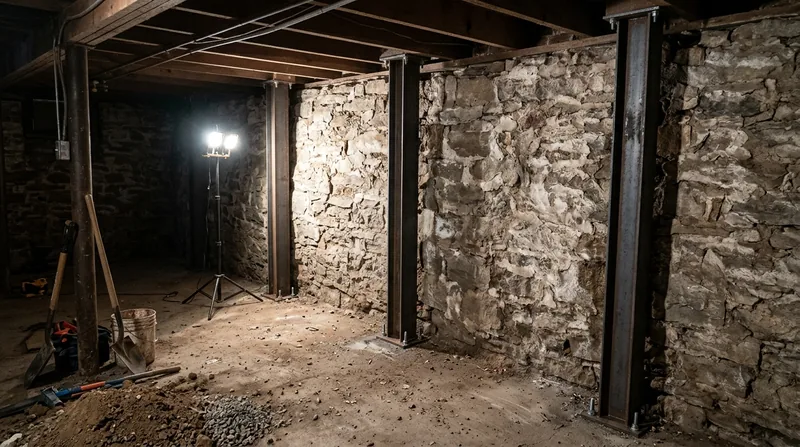




If you have noticed a basement wall leaning inward or a horizontal crack widening across the block, you are dealing with bowing wall repair in Roanoke territory, not a cosmetic crack. The Roanoke Valley sits between the Blue Ridge and the Allegheny ridges on limestone and dolomite bedrock, and the hillside lots above Old Southwest, Wasena, and Raleigh Court push saturated clay against older stone and block walls every spring. Summer thunderstorms send flash runoff down those slopes, and winter freeze-thaw cycles pry open the joints that hold the wall together. Once a wall moves past a quarter inch of lean, gravity and soil pressure work together, and the movement accelerates. We are a dedicated basement waterproofing and foundation specialist, not a general foundation firm and not a plumber, and we tell Roanoke homeowners plainly when carbon fiber straps will hold a wall and when steel I-beams or wall anchors are the honest answer. Start with a free basement inspection before anything else.
Why Bowing Walls Are Common in Roanoke's Older Basements
The housing stock here explains most of the calls. The 1900s-1930s brick and frame foursquares and bungalows in Old Southwest, Wasena, and Downtown often sit on partial basements or cellars built from stone or early block, with no modern footing drain and no waterproof membrane behind the wall. The 1920s-1940s brick bungalows and colonials in Raleigh Court and Grandin Village have full or partial basements where the mortar and block have been wet for decades. Add the 1950s-1960s brick ranches in Melrose and Greenridge and the 1970s-2010s hillside houses, and you have thousands of walls holding back wet clay.
- Hydrostatic pressure from saturated clay soil pushes inward on walls that were never designed for it.
- Freeze-thaw cycles open hairline cracks that let water reach the wall core and weaken it.
- Original footing drains and weeping tile are often clogged, collapsed, or simply absent.
- Efflorescence and white staining on the wall face show water is moving through the masonry.
- Karst conditions on some valley lots send seepage through fractured rock that no surface grading will fix.
Any one of these can start a wall moving, and two or three together make it worse fast.
Key info: A block wall in a 1930s Wasena bungalow that leans two inches at the top is not the same job as a stone cellar wall in Old Southwest that has been bulging for thirty years. The wall material, the soil behind it, and the amount of movement decide the method, and we measure all three before we quote.
Structural foundation repair permits are commonly required in Virginia, and thresholds vary by jurisdiction, so confirm the rules with the City of Roanoke building department before work starts.
How We Stabilize a Bowing Wall in Roanoke
We start by finding out what is actually pushing the wall. That means checking the wall face for plumb, mapping the cracks, probing the soil behind the wall where we can, and looking at how water drains off the roof and the lot. We do not sell a strap kit to a wall that needs anchors, and we do not dig out a hillside lot when an interior drain tile system and a sump pump will relieve the pressure and let the wall dry.
- We inspect the wall, the footing, and the drainage, and we tell you how much movement has occurred and how fast it is progressing.
- We relieve the water pressure first, with an interior perimeter drain and sump basin where the water table is the driver.
- We install carbon fiber straps on block walls with moderate bowing, anchored into the footing and the floor framing.
- We set steel I-beams or wall anchors when the movement is severe or the soil load is too high for straps alone.
- We seal the wall face and repair the parging so the masonry stops taking on water.
- We check the discharge line and the grading so runoff leaves the foundation instead of soaking back into the clay.
Every job ends with a written record of the wall's position so you can see whether it has moved after the repair.
Key info: On a Grandin Village colonial, a rear wall had bowed about an inch and a half with a horizontal crack running the full length. We installed carbon fiber straps on twelve-inch centers and tied the drainage into a new sump basin. Two winters later the wall has not moved. On a steeper Cave Spring lot, the same symptom needed wall anchors because the clay load was too high for straps.
If the wall is moving because of water, the fix has to include drainage. See how we handle interior drain tile systems alongside the structural work.
Bowing Wall Repair Methods Compared
No single method fits every wall. The table below shows what we use and when, based on the wall material, the severity of the movement, and the soil load on the hillside lots around Roanoke.
| Approach | Description | Best for |
|---|---|---|
| Carbon fiber straps | Straps bonded to the wall face and anchored top and bottom to resist inward movement. | Moderate bowing on block walls with cracks under a quarter inch. |
| Steel I-beams | Vertical steel beams set against the wall and tied into the floor and footing. | Walls with significant lean or where straps cannot develop enough load. |
| Wall anchors | Anchors set in the soil outside pull the wall back through rods and plates. | Hillside lots with high clay pressure and room to excavate outside. |
| Drainage relief | Interior perimeter drain and sump pump reduce hydrostatic pressure behind the wall. | Walls moving because of a high water table or failed footing drain. |
| Epoxy or polyurethane injection | Injection ports seal active cracks and fill voids in the wall core. | Hairline and shrinkage cracks that are not yet structural. |
We match the method to the wall, not the other way around, and we explain why we chose it.
Bowing Wall Repair Cost in Roanoke: What to Expect
Most homeowners want a number before they call, and that is fair. Carbon fiber strap work typically starts from $600 for a small, accessible section, and the price climbs with the number of straps, the wall height, and how much prep the wall needs. Wall anchors and steel I-beams cost more because they involve excavation, steel, and more labor. A wall that also needs drainage relief will carry that cost on top. The honest answer is that no two walls are the same, and a quote given over the phone without seeing the wall is a guess.
Factors that move the number: the length and height of the bowed section, whether the wall is block, stone, or poured concrete, how far the wall has moved, access for equipment on a steep Cave Spring or Hollins lot, and whether the footing drain has to be replaced. Getting two or three estimates is smart, and any contractor who will not put the method and the scope in writing is one to skip. Our full pricing overview breaks down the ranges.
Bowing Wall Repair Near Me: How to Choose a Contractor in Roanoke
You want a contractor who has actually worked on Roanoke's older basements, not a franchise passing through. Ask for the license and insurance certificate, and confirm the coverage is current. Ask how many bowing walls they have stabilized in the valley and what methods they used. Ask who pulls the permit and whether the work is inspected. Then get the estimate in writing with the method, the materials, and the scope spelled out.
- Confirm the contractor is licensed and insured in Virginia and ask to see the certificate.
- Get two or three written estimates and compare the method, not just the total.
- Ask for references from jobs in Roanoke, Salem, or Vinton you can call.
- Ask whether a structural permit is required and who files it with the city.
- Check HOA rules for any neighborhood with exterior work restrictions before signing.
When you are ready, reach out through our contact page and we will set up the inspection.
Bowing Wall Repair in Roanoke: Pricing Guide
| Service | Price | Details |
|---|---|---|
| Carbon fiber strap repair (small section) | Starting at $600 | Covers a short, accessible bowed section with straps on standard spacing. |
| Full wall carbon fiber strapping | Starting at $1,800 | Multiple straps across a full wall, including prep and anchoring into footing. |
| Steel I-beam or wall anchor system | On estimate | Heavy movement or high clay load needs an on-site look before pricing. |
| Drainage relief combined with structural repair | On estimate | Interior drain and sump work priced after the wall and water source are assessed. |
| Travel | Included | in Roanoke and surrounding areas, no separate call-out or mileage fee |
| Estimate | Free | Response within 24h at (540) 900-0386, no obligation to book |
Indicative pricing, the exact cost depends on square footage, finish, and site access. Free personalized estimate within 24h at (540) 900-0386.


