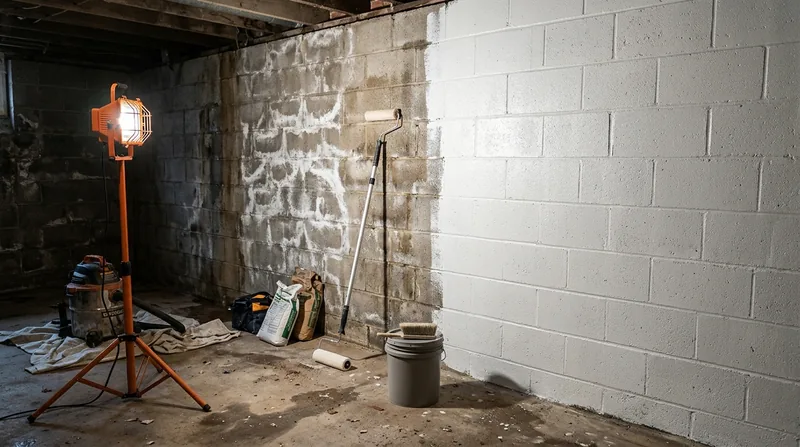




Roanoke sits in a valley between the Blue Ridge and the Allegheny ridges, on limestone and dolomite bedrock that sends water sideways through fractured rock and karst seams. That geology is why Basement Wall Sealing in Roanoke is rarely a cosmetic job. In Old Southwest and Wasena, 1900s brick foursquares and bungalows sit on stone or early block cellar walls that wick groundwater all summer. In Raleigh Court and Grandin Village, 1920s to 1940s brick bungalows have full or partial basements that show white efflorescence after every thunderstorm. On the valley slopes, homes built from the 1970s through the 2010s take hillside runoff against poured walls. We prep, clean, and seal damp basement walls, and we tell you when sealing is the honest fix and when hydrostatic pressure means a sealer will fail. Call (540) 900-0386 for a free basement inspection. If you also see water at the floor joint, start with basement waterproofing in Roanoke.
Why Basement Wall Sealing Matters in Roanoke's Old Cellars and Hillside Homes
Most of the damp walls we open up in Roanoke are not leaking through a hole. They are breathing moisture through old brick, stone, and early block, or through hairline cracks that open and close with the winter freeze-thaw cycle. Summer thunderstorms push flash runoff down the hillsides and along Tinker Creek, and the water table rises against the footing. That combination is what leaves the chalky white bloom on a wall in Melrose or Greenridge.
- Efflorescence appears when water moves through masonry and leaves mineral salts on the surface.
- Hairline cracks widen each winter as freeze-thaw cycles work the wall.
- Damp walls raise basement humidity, which feeds mold growth on framing and stored goods.
- Sealing without fixing the water source traps moisture behind the coating and makes the problem worse.
We test the wall before we recommend a sealer, because a damp wall and a pressurized wall need different answers.
Key info: A 1928 brick bungalow off Grandin Road showed efflorescence only on the uphill wall. The wall was damp but not pressurized, so cleaning and a breathable penetrating sealer solved it. A 1962 ranch in Greenridge showed the same bloom, but water was entering at the floor joint under pressure, and no sealer would have held there.
Virginia's building codes are adopted statewide but enforced locally, so confirm permit thresholds with the City of Roanoke building department before any work that alters drainage.
How We Seal Basement Walls in Roanoke, Step by Step
We start by finding out why the wall is wet. Sometimes the answer is a failed downspout or grading that slopes back to the house. Sometimes it is a footing drain that has been clogged since the 1950s. Sometimes it is true hydrostatic pressure, and then sealing alone is the wrong tool. The steps below are the sequence we follow on a wall that is a good candidate for sealing.
- We inspect the wall, the floor joint, the window wells, and the exterior grade to locate the moisture source.
- We remove efflorescence, old paint, and loose parging so the sealer bonds to sound masonry.
- We inject active cracks with epoxy or polyurethane rather than hiding them under a coating.
- We apply a penetrating sealer on damp masonry or a membrane sealer where the wall stays dry enough to hold it.
- We correct grading and downspout extensions so roof water discharges away from the foundation.
If the inspection shows pressure at the floor joint, we say so and explain why an interior perimeter drain is the better spend.
Key info: A homeowner in Cave Spring had paid twice for sealer on a bowing uphill wall. The wall had moved, and the crack reopened each season. The fix was crack injection plus carbon fiber straps, not another coat of sealer. You can read more about that path on our bowing wall repair page.
Sealing Approaches We Use and When Each One Fits
Not every damp wall takes the same product. Brick and stone need to breathe, poured walls can take a membrane, and an active crack needs injection before anything goes on the surface. This table shows how we match the approach to the wall.
| Approach | Description | Best for |
|---|---|---|
| Penetrating sealer | Soaks into masonry and blocks capillary moisture without trapping vapor. | Damp brick and stone cellar walls in Old Southwest. |
| Membrane sealer | Forms a flexible film on the interior face of a dry, sound wall. | Poured walls in 1970s and later hillside homes. |
| Epoxy injection | Ports are set along the crack and structural epoxy is pumped in. | Settled, non-moving cracks in poured and block walls. |
| Polyurethane injection | Flexible foam fills the crack and stays sealed as the wall moves. | Hairline cracks that open and close with freeze-thaw. |
| Parging repair | Failed mortar is cut out and replaced before sealing. | Crumbling stone and early block walls in Wasena. |
We choose the approach after the inspection, not before, because the wall decides what will actually hold.
Basement Wall Sealing Cost in Roanoke: What to Expect
Most residential sealing jobs in the Roanoke Valley start around $1,500, and that figure covers a typical single-wall or partial-basement job with cleaning, efflorescence removal, and a sealer. A full basement on a 1950s brick ranch in Melrose runs higher than one wall in a small cellar. Crack injection is priced by the linear foot, and a wall that needs parging repair before sealing adds labor.
The factors that move the number are wall length, wall material, how much prep the masonry needs, access to the basement, and whether we find active pressure that changes the scope. A job that starts as sealing and turns into an interior drain tile system is a bigger number, and we tell you that before we start. Getting two or three estimates is smart, and we would rather you compare scope than compare a single line item. Our full pricing overview breaks down the ranges.
Hiring a Basement Wall Sealing Contractor Near Roanoke: What to Check
Basement wall sealing near me is a search that turns up a lot of general handymen and a few specialists. The difference matters, because a sealer applied over an active leak hides the problem for a season and then fails.
- Confirm the contractor is licensed and insured, and ask to see the certificate.
- Get two or three written estimates that describe the scope, not just a price.
- Ask whether the estimate includes crack injection and prep or only the coating.
- Ask who pulls the permit if the job alters drainage or a sump discharge connection.
- Check that the quote states a transferable warranty in writing.
If a contractor will not put the scope and the warranty in writing, keep looking. You can reach us through our contact page to schedule the free inspection.
Basement Wall Sealing in Roanoke: Pricing Guide
| Service | Price | Details |
|---|---|---|
| Single wall sealing | Starting at $1,500 | Includes cleaning, efflorescence removal, and one penetrating or membrane sealer coat on a typical wall. |
| Full basement perimeter sealing | Starting at $2,800 | Covers all walls, with prep time driven by masonry condition and total wall length. |
| Crack injection (epoxy or polyurethane) | Starting at $450 per crack | Priced by linear foot; moving hairline cracks take flexible polyurethane rather than rigid epoxy. |
| Parging repair before sealing | On estimate | Failed mortar on stone or early block walls must be cut out and replaced before any sealer goes on. |
| Travel | Included | In Roanoke and surrounding areas, no separate call-out or mileage fee. |
| Estimate | Free | Response within 24h at (540) 900-0386, no obligation to book. |
Indicative pricing, the exact cost depends on square footage, finish, and site access. Free personalized estimate within 24h at (540) 900-0386.


