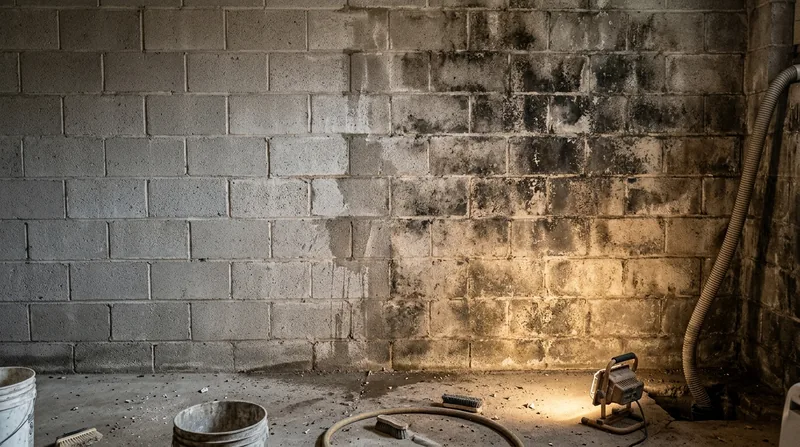




If you live in one of the 1920s brick bungalows off Grandin Road or a stone-foundation foursquare in Old Southwest, you already know how Roanoke's wet seasons treat a basement. Summer thunderstorms send flash runoff down the valley slopes, and winter freeze-thaw cycles open hairline cracks that let water seep in slowly. When that moisture sits against block or stone walls, mold follows. Basement Mold Remediation in Roanoke means removing the growth and fixing the moisture source behind it, not just spraying the walls and hoping. We handle the remediation and the drainage work that keeps it from coming back. Call (540) 900-0386 to schedule a free basement inspection. You can also read our basement waterproofing service page to understand the full scope of moisture control.
Why Basement Mold Grows in Roanoke's Older Housing Stock
Roanoke's residential core sits on limestone and dolomite bedrock, and that geology matters. Water moves through fractured rock and karst seams, so some lots in Raleigh Court and Wasena see seepage that has nothing to do with a visible crack. Add the valley's humid summers and the hydrostatic pressure that builds after a heavy rain, and a partial cellar with early block walls becomes a moisture trap. Mold needs three things: moisture, organic material (wood framing, paper-faced drywall, cardboard), and still air. We find all three in most pre-1950 basements.
- Efflorescence on the wall is a sign that water is moving through the masonry, not just condensing on it.
- A musty basement smell that never clears usually points to damp framing or a failed vapor barrier.
- White or black growth along the base of a wall tracks the water line from the last storm.
- Peeling paint and soft drywall near the floor mean moisture has been wicking up for a while.
Any one of those symptoms is worth a look before the next wet season. For permitting questions about structural or drainage work, the City of Roanoke building department is the authority, and rules vary by jurisdiction.
Key info: A 1930s bungalow in Grandin Village with a stone foundation and no footing drain will wick groundwater after every heavy rain. Remediation without drainage work is a temporary fix at best.
How We Run Basement Mold Remediation in Roanoke
We start with the moisture, not the mold. A free inspection maps where water is entering (wall cracks, cove joint, window wells, failed parging) and how much of the basement is affected. Then we set up containment so spores do not spread to the rest of the house during removal. Only after the source is identified do we treat and remove affected materials. If the real problem is hydrostatic pressure, we recommend an interior drain tile system rather than repeated cleanups.
- We inspect the basement, test for moisture with a meter, and document the affected area with photos.
- We set up negative air pressure and plastic containment around the work zone.
- We remove porous materials that cannot be cleaned (drywall, insulation, cardboard) and bag them on site.
- We treat structural surfaces with an antimicrobial and HEPA-vacuum the space.
- We correct the moisture source: crack injection, wall sealing, drainage, or a dehumidifier sized to the space.
- We verify dryness with a meter before we close out the job.
The step most homeowners skip is the last one. Without a moisture fix, mold returns within a season. If your basement needs drainage work, see our interior drain tile system page for how we handle it.
Local example: A 1958 brick ranch in Melrose had mold along the bottom two feet of a block wall and a musty smell in the hallway above. The cause was a clogged footing drain and a downspout that dumped at the corner. We remediated the wall, cleared the drain, and added a downspout extension. No growth returned the following spring.
Remediation Approaches We Use
Not every mold job is the same. A small surface patch on a block wall is a different scope from a finished basement with soaked drywall. The table below shows the approaches we use in Roanoke basements and when each one fits.
| Approach | Description | Best for |
|---|---|---|
| Surface treatment and cleaning | Antimicrobial treatment and HEPA vacuuming of block, stone, and concrete surfaces. | Small patches on unfinished masonry walls. |
| Containment and material removal | Plastic sheeting, negative air, and bagged removal of affected drywall and insulation. | Finished basements with soaked framing or drywall. |
| Moisture source correction | Crack injection, wall sealing, or drainage work to stop water at the entry point. | Any basement with active seepage or high humidity. |
| Dehumidification | Sizing and installing a dehumidifier to hold basement humidity in a safe range. | Tight basements with condensation but no active leaks. |
| Post-remediation verification | Moisture meter checks and a visual walkthrough before the job is closed. | Every job, no exceptions. |
We match the approach to the moisture reading, not to a flat package price.
Basement Mold Remediation Cost in Roanoke: What to Expect
Most basement mold remediation jobs in Roanoke start around $1,500 and go up from there. That figure covers a contained work area, surface treatment, and HEPA cleanup on an unfinished basement. A finished basement with soaked drywall, a larger affected area, or a moisture source that needs drainage work will run higher, often in the $3,000 to $6,000 range. We give you a written scope before any work begins so you know what you are paying for.
- Square footage of affected area is the biggest cost driver.
- Finished walls and ceilings mean more removal and more containment.
- Whether a moisture fix (crack injection, drain tile, sump pump) is needed alongside remediation.
- Access: a narrow Old Southwest cellar stair is slower to work in than a wide Melrose basement.
- Whether a dehumidifier needs to be added to control humidity long term.
Get two or three estimates and compare scope, not just the bottom line. Our full pricing overview is at roanoke-waterproofing.com/pricing.
Basement Mold Remediation Near Me: How to Vet a Contractor Near Roanoke
Anyone can buy a sprayer and a respirator. The difference is whether the contractor diagnoses the moisture source and stands behind the work. Here is what we tell homeowners to check before they sign anything, whether they hire us or someone else.
- Ask for the license and insurance certificate, and confirm the general liability and workers' comp coverage are current.
- Get at least three written estimates that list the scope, the containment plan, and the moisture fix separately.
- Ask for local references, ideally a job in a similar house style (stone cellar, block wall, finished basement).
- Ask who pulls the permit if the job includes structural or drainage changes; rules vary by jurisdiction.
- Confirm in writing whether a transferable warranty applies and what it covers.
If a contractor will not put the moisture fix in writing, keep looking. You can reach us through the contact page to schedule a free inspection.
Basement Mold Remediation in Roanoke: Pricing Guide
| Service | Price | Details |
|---|---|---|
| Surface remediation (unfinished basement) | Starting at $1,500 | Includes containment, antimicrobial treatment, HEPA cleanup, and moisture verification on affected masonry walls. |
| Finished basement remediation | Starting at $3,000 | Adds removal of affected drywall and insulation, negative air containment, and disposal; area size moves the price. |
| Remediation plus moisture fix | On estimate | Combines remediation with crack injection, drainage, or sump work; scope needs an on-site look before pricing. |
| Dehumidifier sizing and installation | Starting at $1,200 | Includes unit, installation, and humidity baseline; basement volume and existing drainage affect the final figure. |
| Travel | Included | in Roanoke and surrounding areas, no separate call-out or mileage fee. |
| Estimate | Free | Response within 24h at (540) 900-0386, no obligation to book. |
Indicative pricing, the exact cost depends on square footage, finish, and site access. Free personalized estimate within 24h at (540) 900-0386.


